Intersection-free Garment Retargeting
1New York University · 2Roblox
SIGGRAPH Conference Papers ’25
Abstract
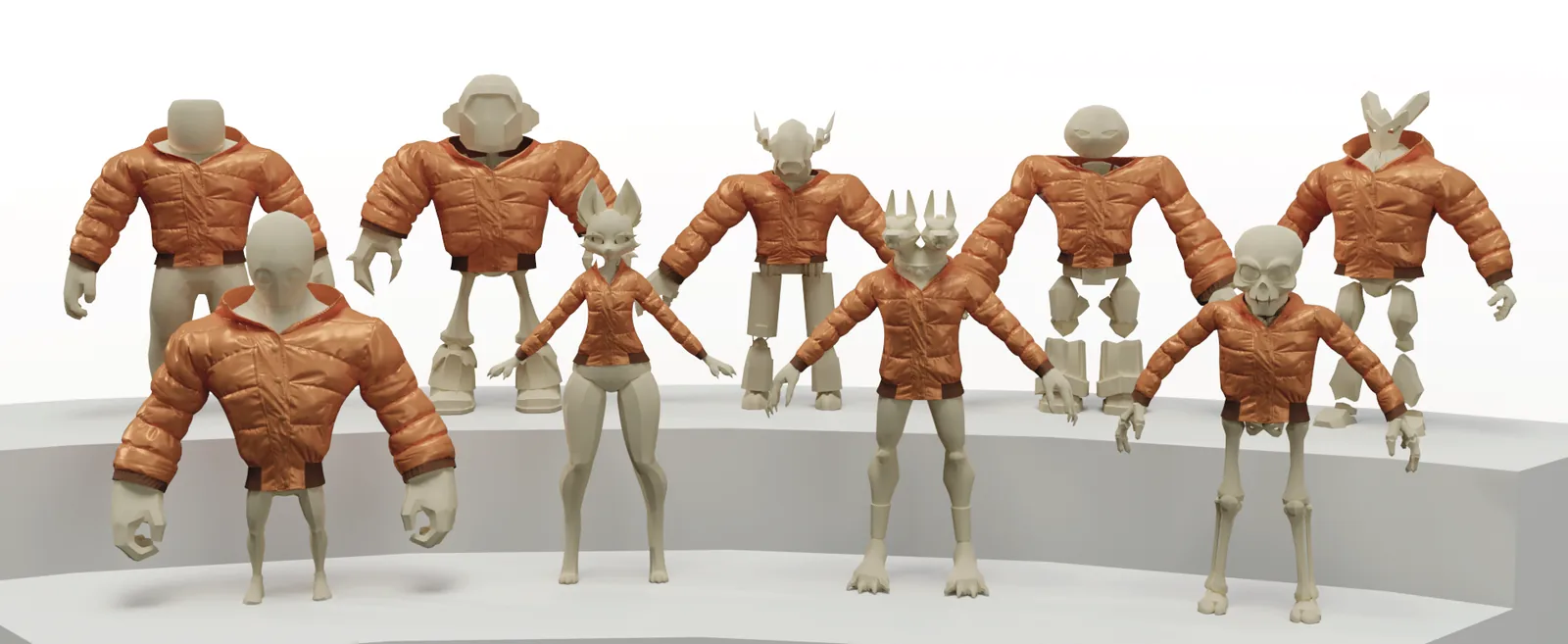
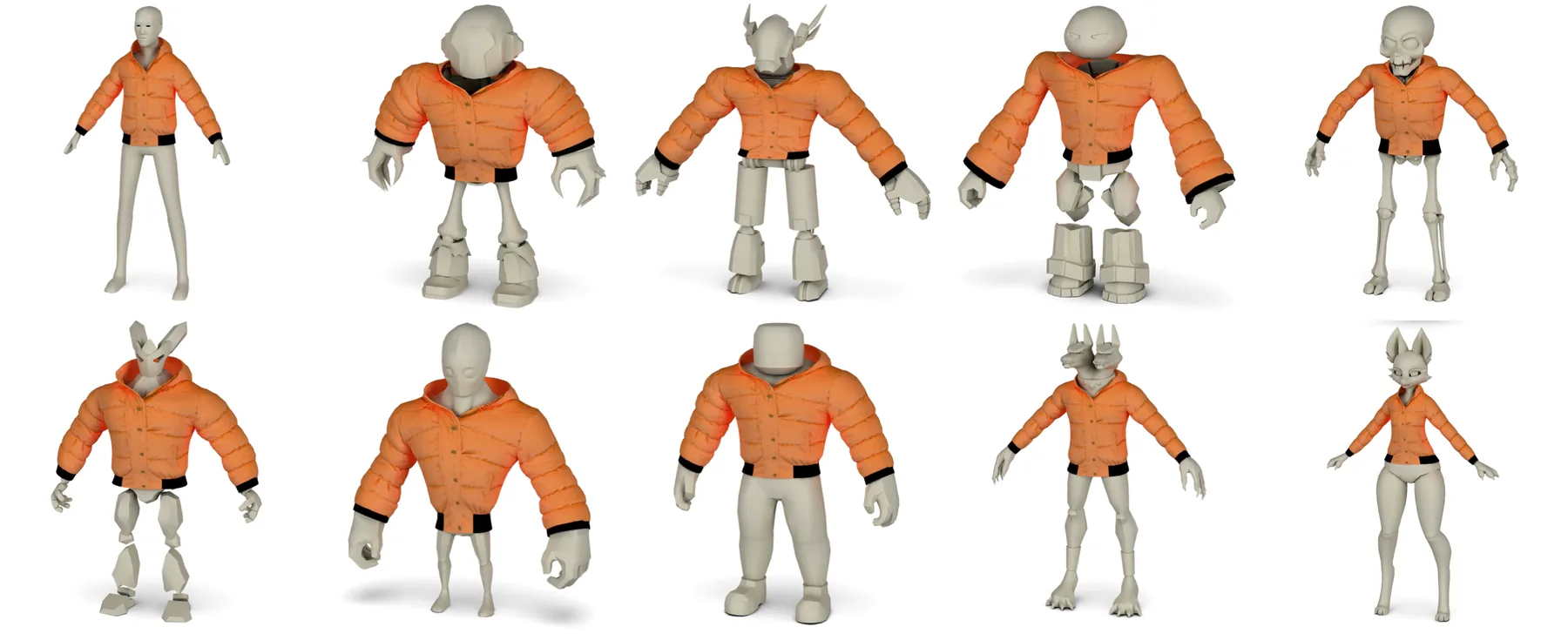
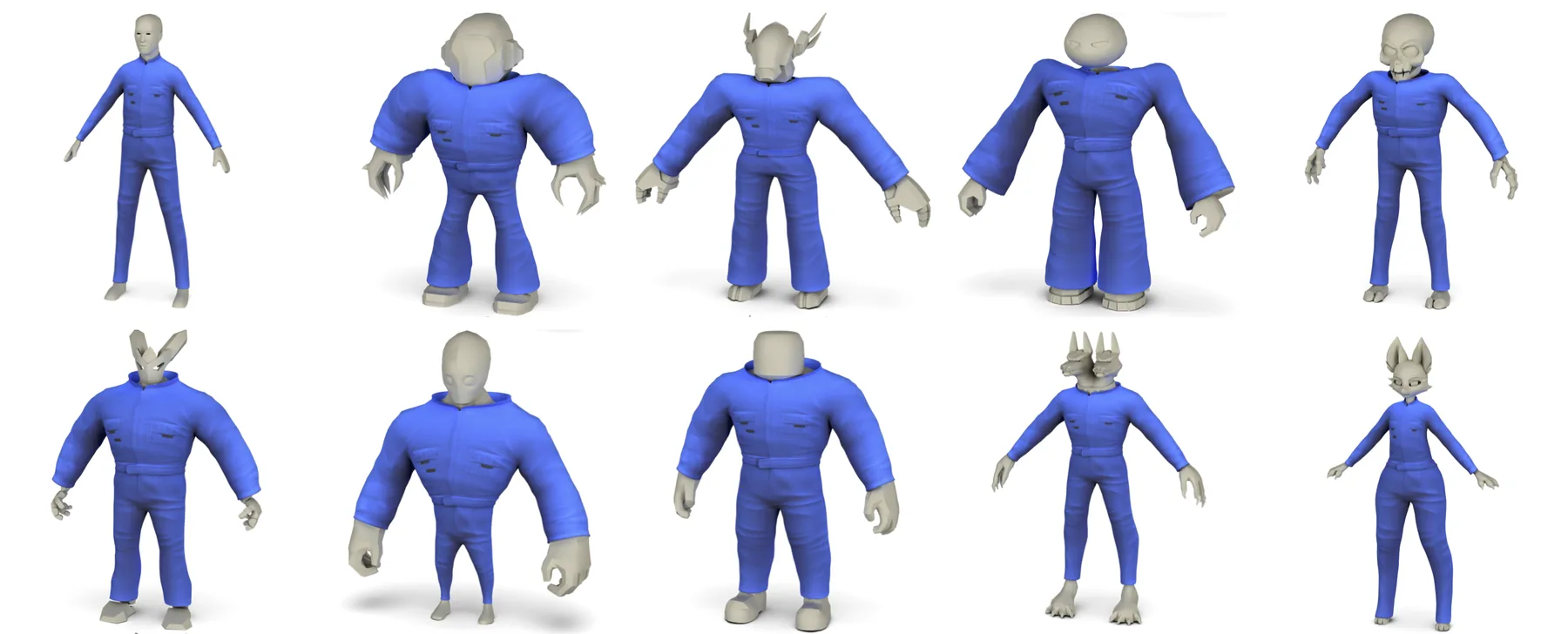
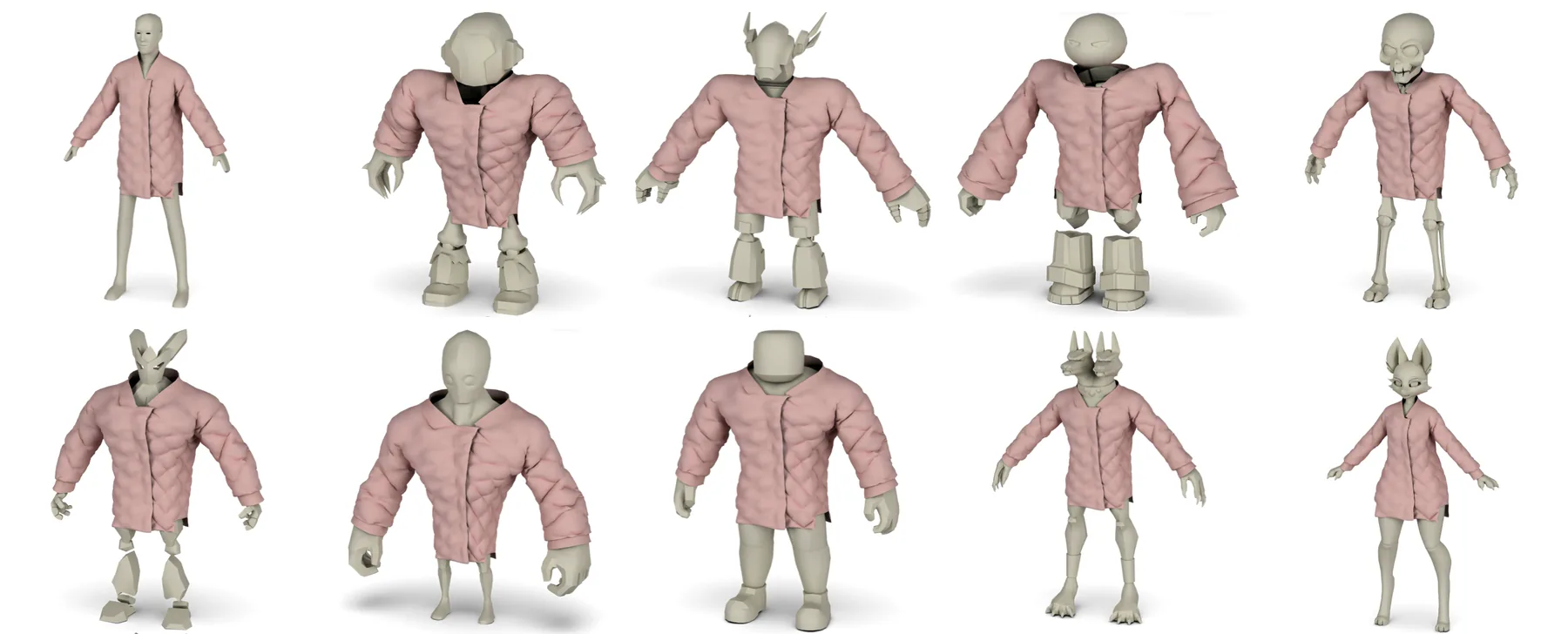
Retargeting methods deform an existing garment design from one avatar to another, saving the manual effort of redesigning it. Previous work is limited to human bodies with small shape variation, while games and animation are full of characters with proportions that defy human norms. We propose a training-free method that optimizes directly on the garment mesh, combining loss functions that preserve the geometric features of the original design, guarantee intersection-free results, and fit the garment adaptively to the target. The output is a simulation-ready garment model.
Results
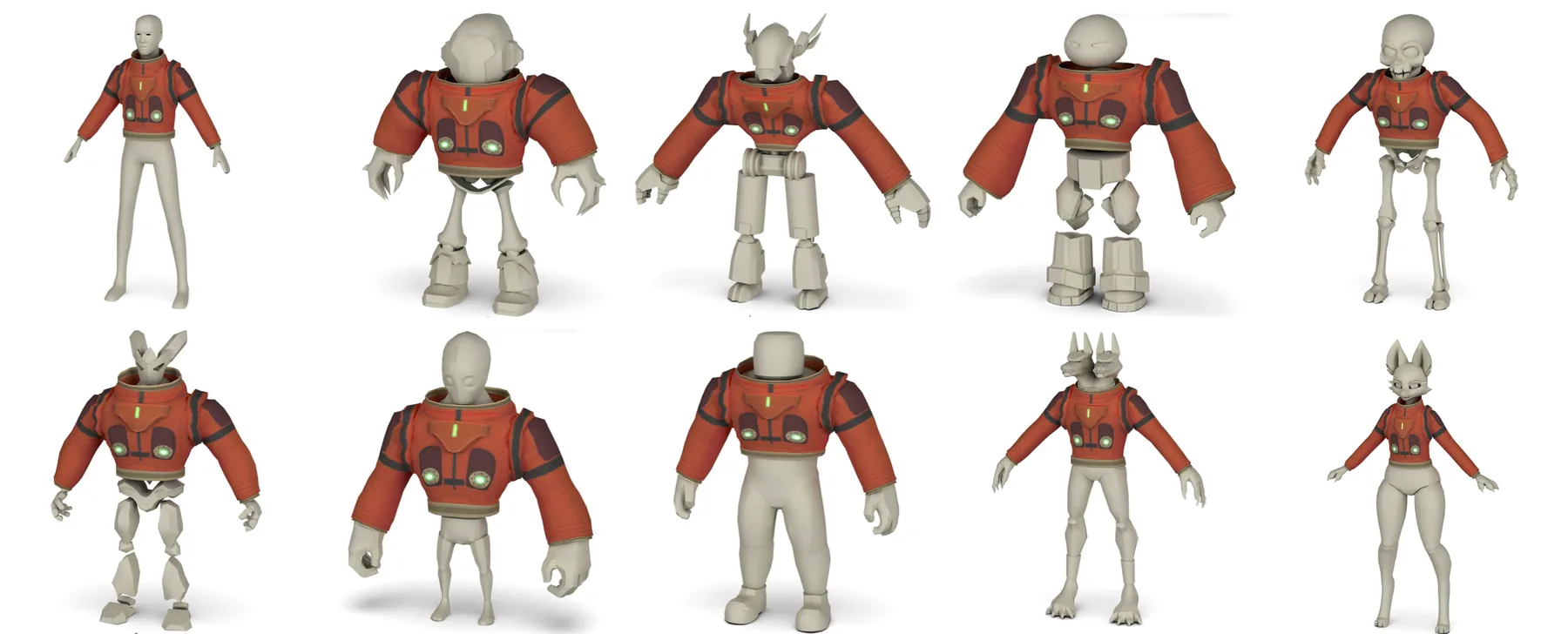
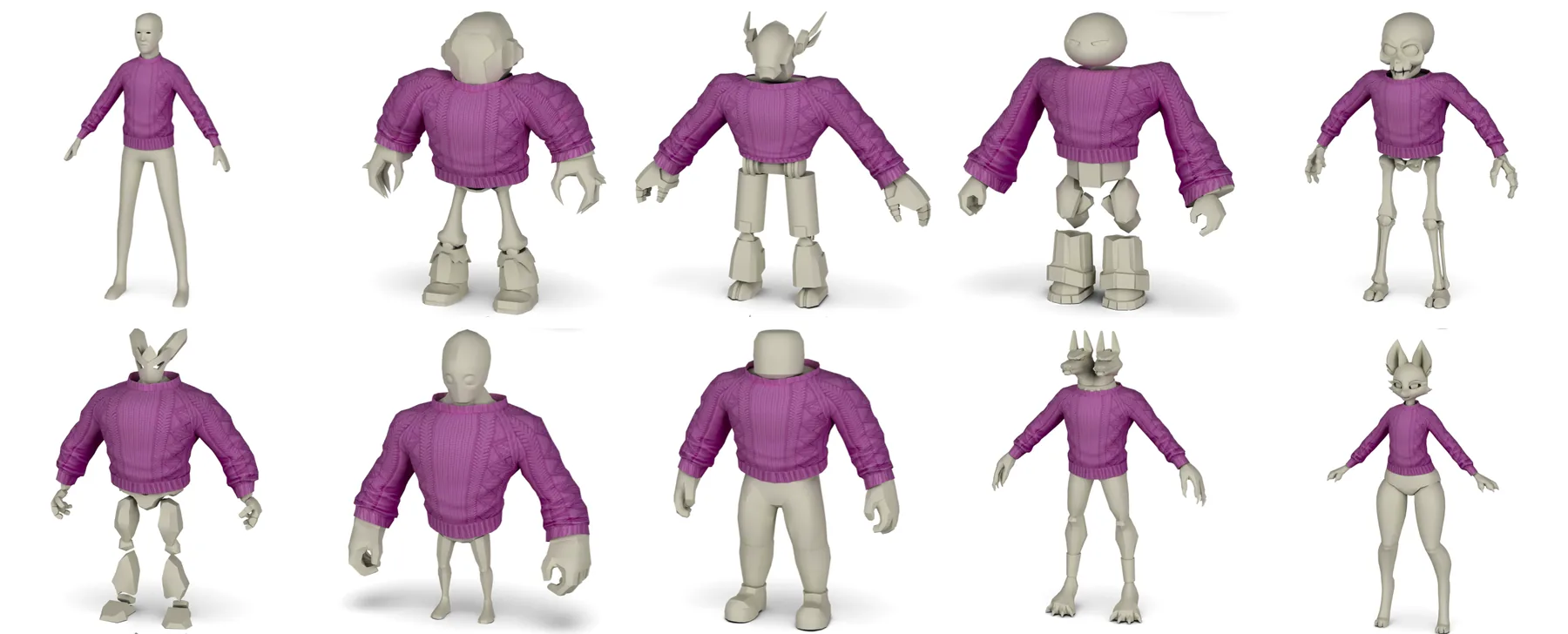
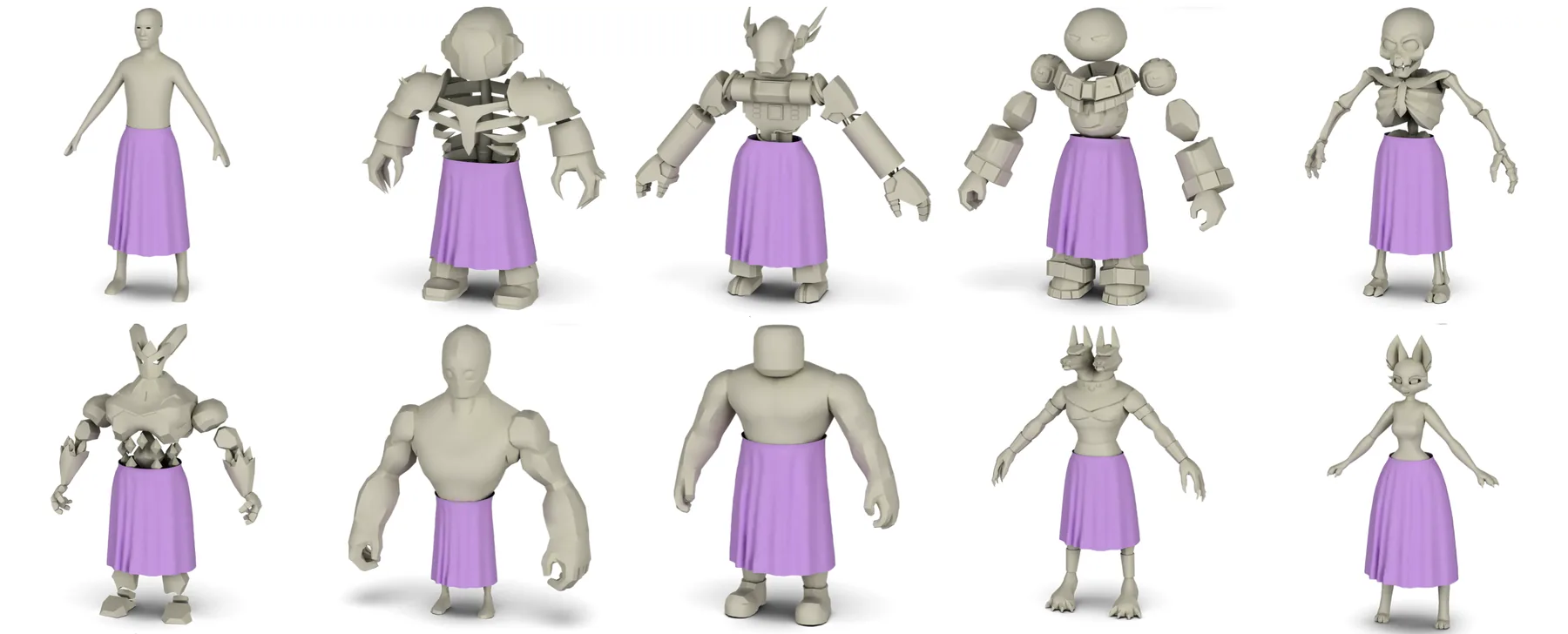
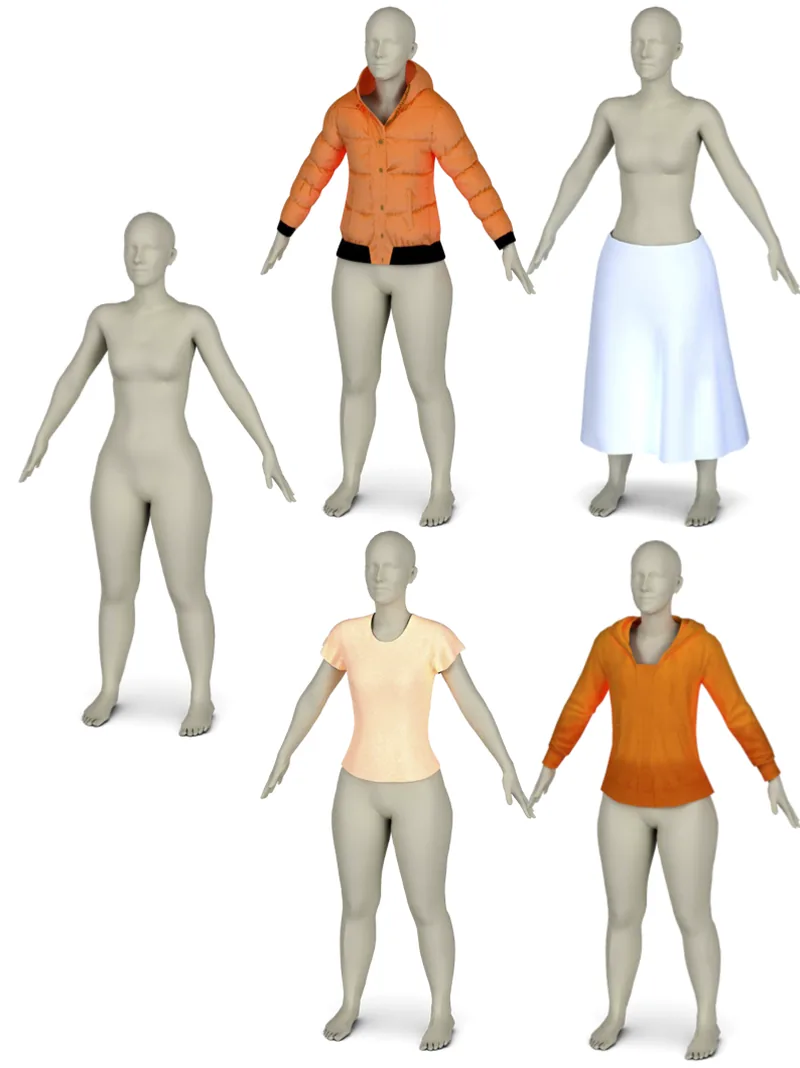
SMPL human models
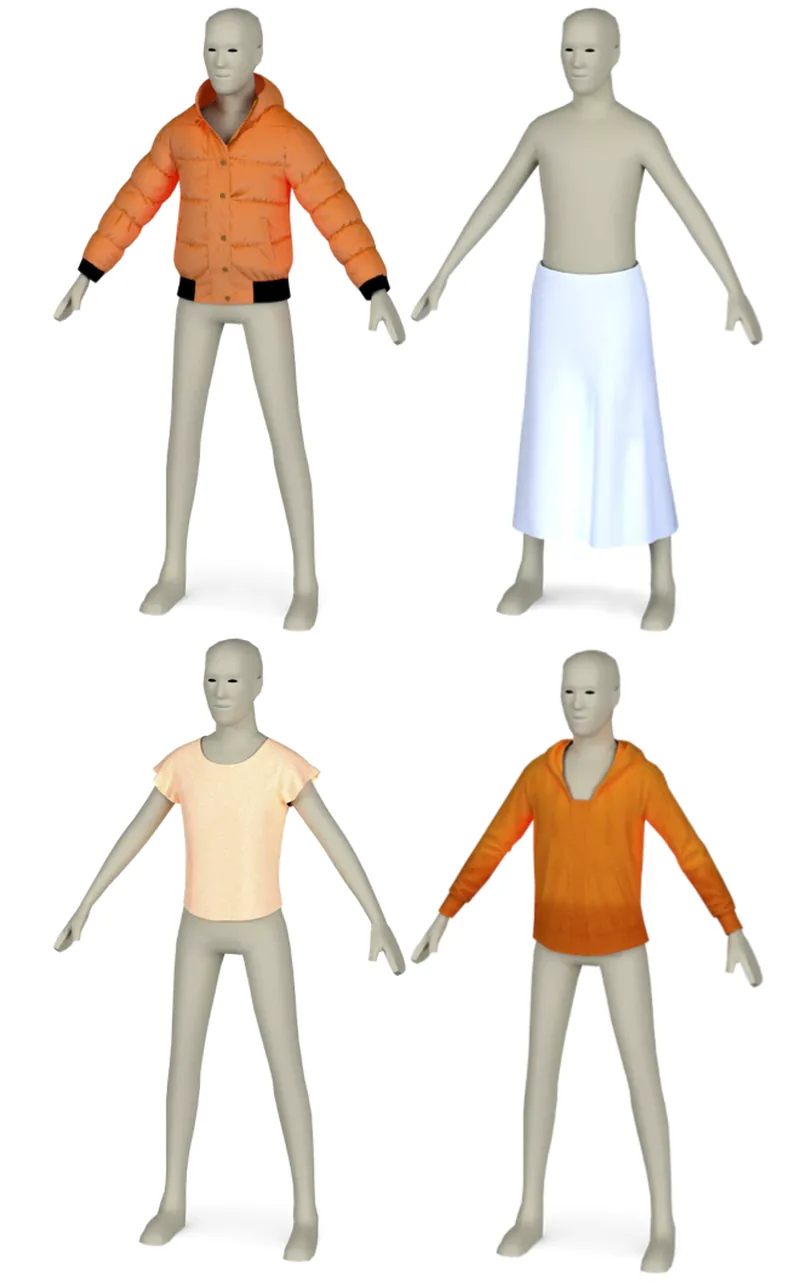
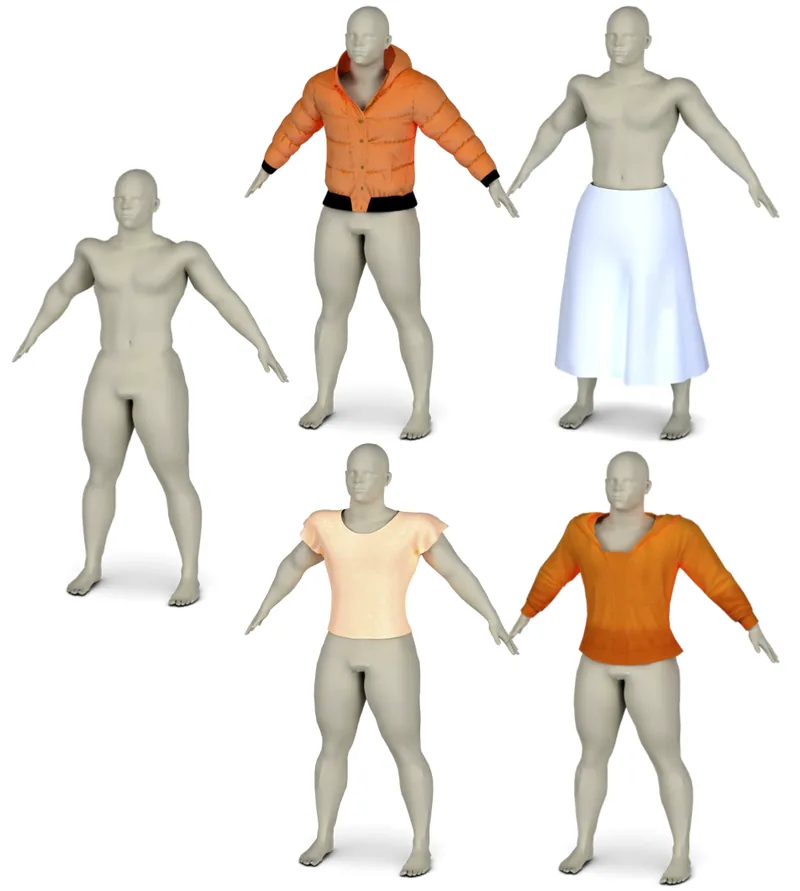
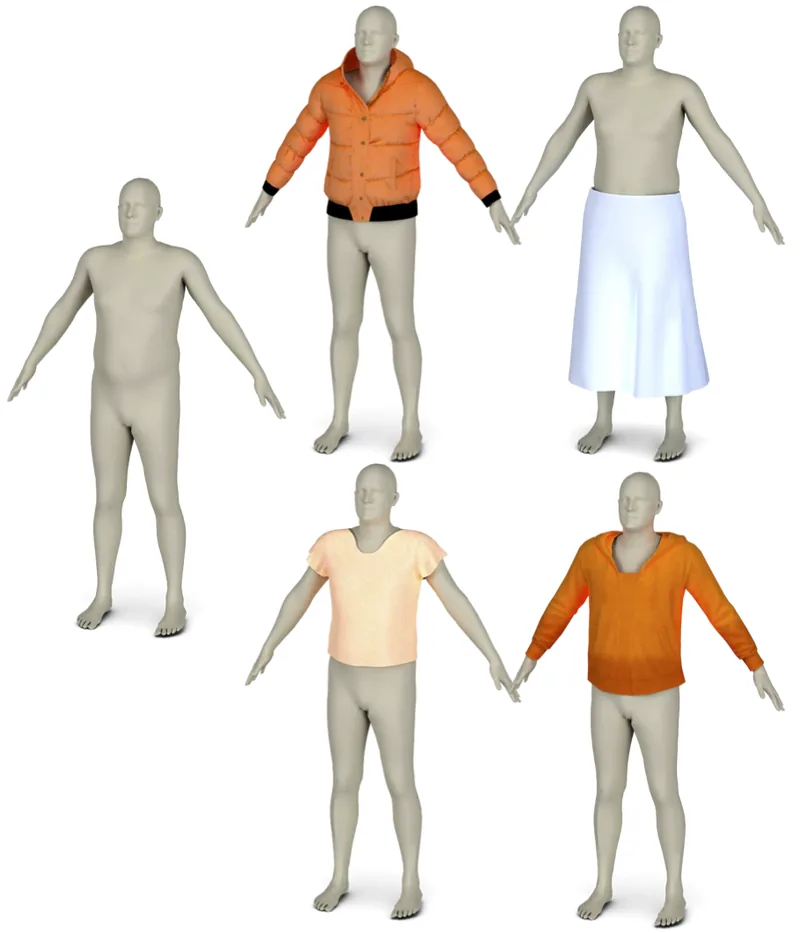
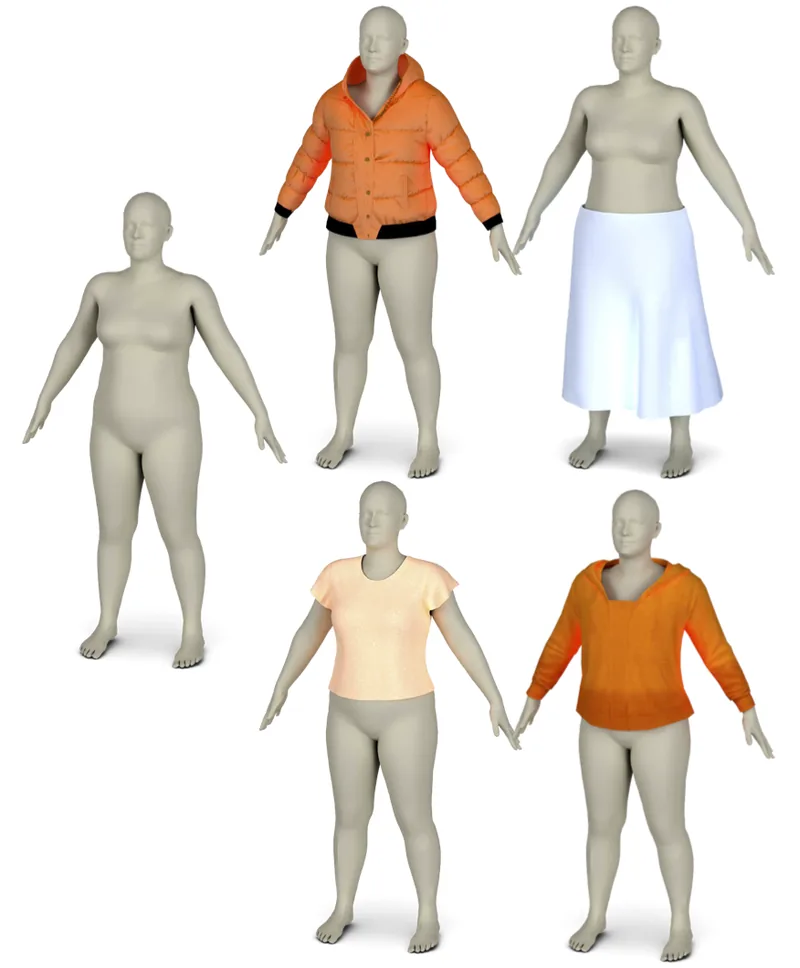
Method
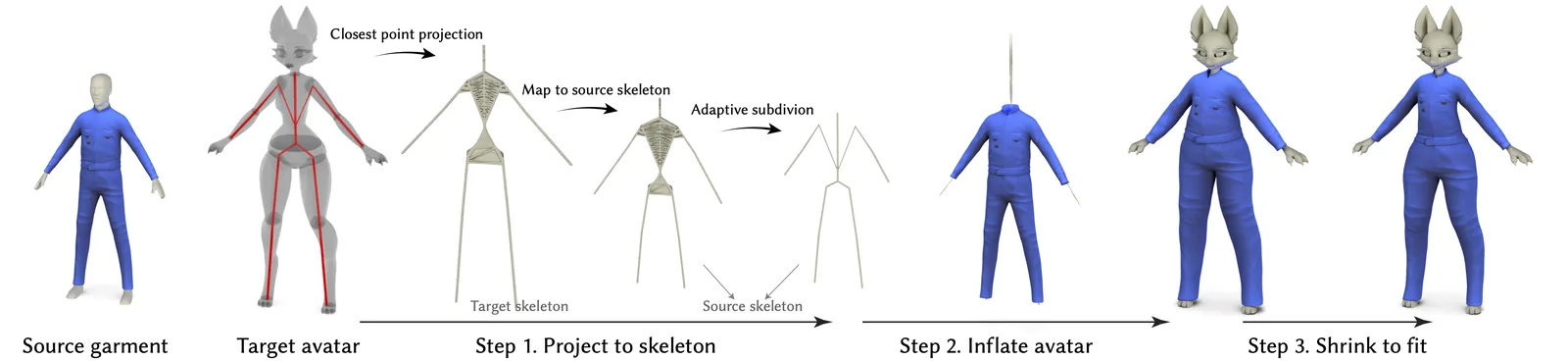
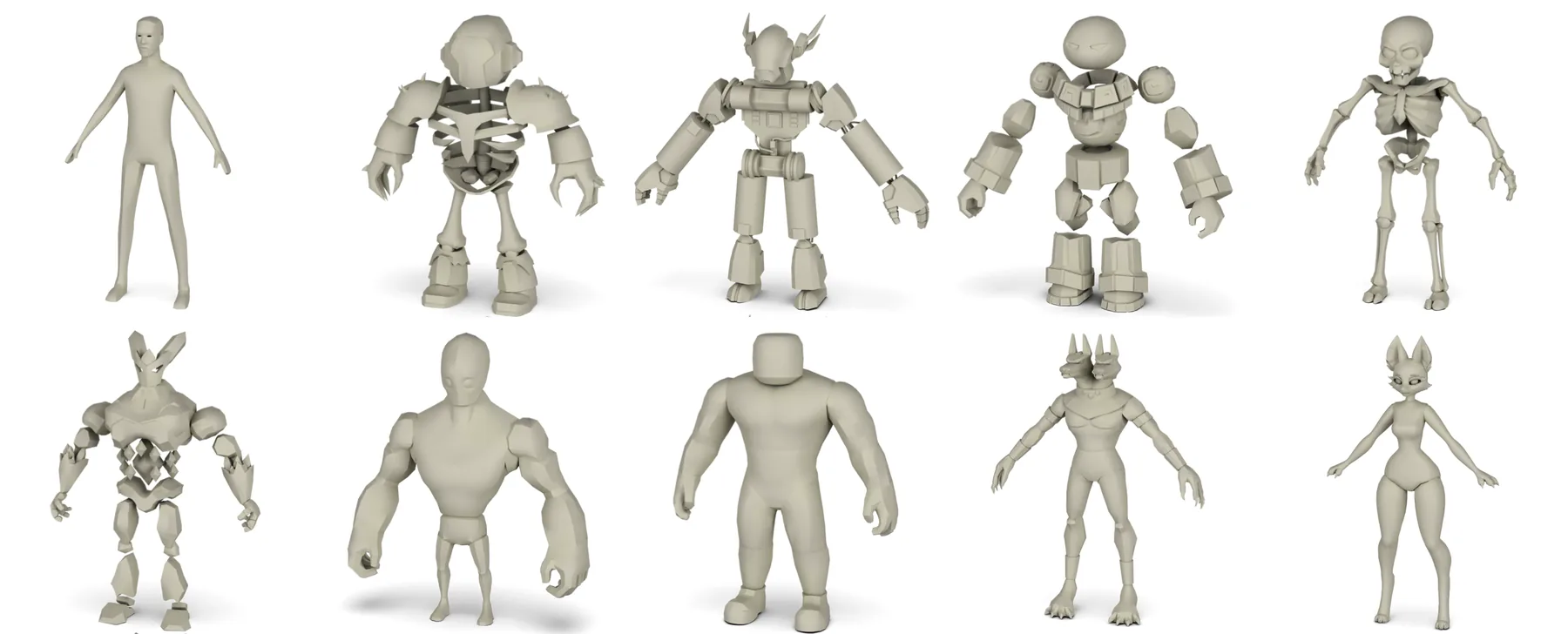
Both avatars are triangular meshes with an animation skeleton. We assume no surface correspondence between them, which is what lets the method handle proportions and topology far from the mannequin's.
1. Initialize. Rather than deform the garment onto the avatar, we shrink the avatar onto its own skeleton and map that skeleton to the source, so every limb starts inside the correct sleeve.
2. Inflate. An augmented-Lagrangian term drives the avatar back to its true shape while the garment deforms around it, never intersecting.
3. Fit. With the avatar fixed and converted to a signed distance field, the garment alone is pulled onto the body until convergence.
Four objectives run throughout: a contact barrier from IPC that keeps every primitive pair at positive distance, a surface term that preserves local shape, a positional term defined relative to the skeleton bones, and a boundary-curve term that holds the curvature and torsion of each hem and cuff.
Citation
@inproceedings{10.1145/3721238.3730590,
  author    = {Huang, Zizhou and Ara\'{u}jo, Chrystiano and Kunz, Andrew
               and Zorin, Denis and Panozzo, Daniele and Zordan, Victor},
  title     = {Intersection-Free Garment Retargeting},
  booktitle = {Special Interest Group on Computer Graphics and Interactive
               Techniques Conference Conference Papers (SIGGRAPH Conference
               Papers '25)},
  year      = {2025},
  isbn      = {979-8-4007-1540-2},
  numpages  = {11},
  location  = {Vancouver, BC, Canada},
  publisher = {Association for Computing Machinery},
  address   = {New York, NY, USA},
  doi       = {10.1145/3721238.3730590},
  url       = {https://doi.org/10.1145/3721238.3730590}
}