Optimized Shock-protecting Microstructures
New York University
ACM Transactions on Graphics (SIGGRAPH Asia 2024)
Abstract
We use shape optimization and topology search to design families of microstructures approximating the ideal shock-protecting behavior. We present an algorithmic pipeline for the optimal design of such families combining differentiable nonlinear homogenization with self-contact and an optimization algorithm. We fabricate the designs with existing 3D printing technologies and validate their effectiveness through experimental testing.
Results
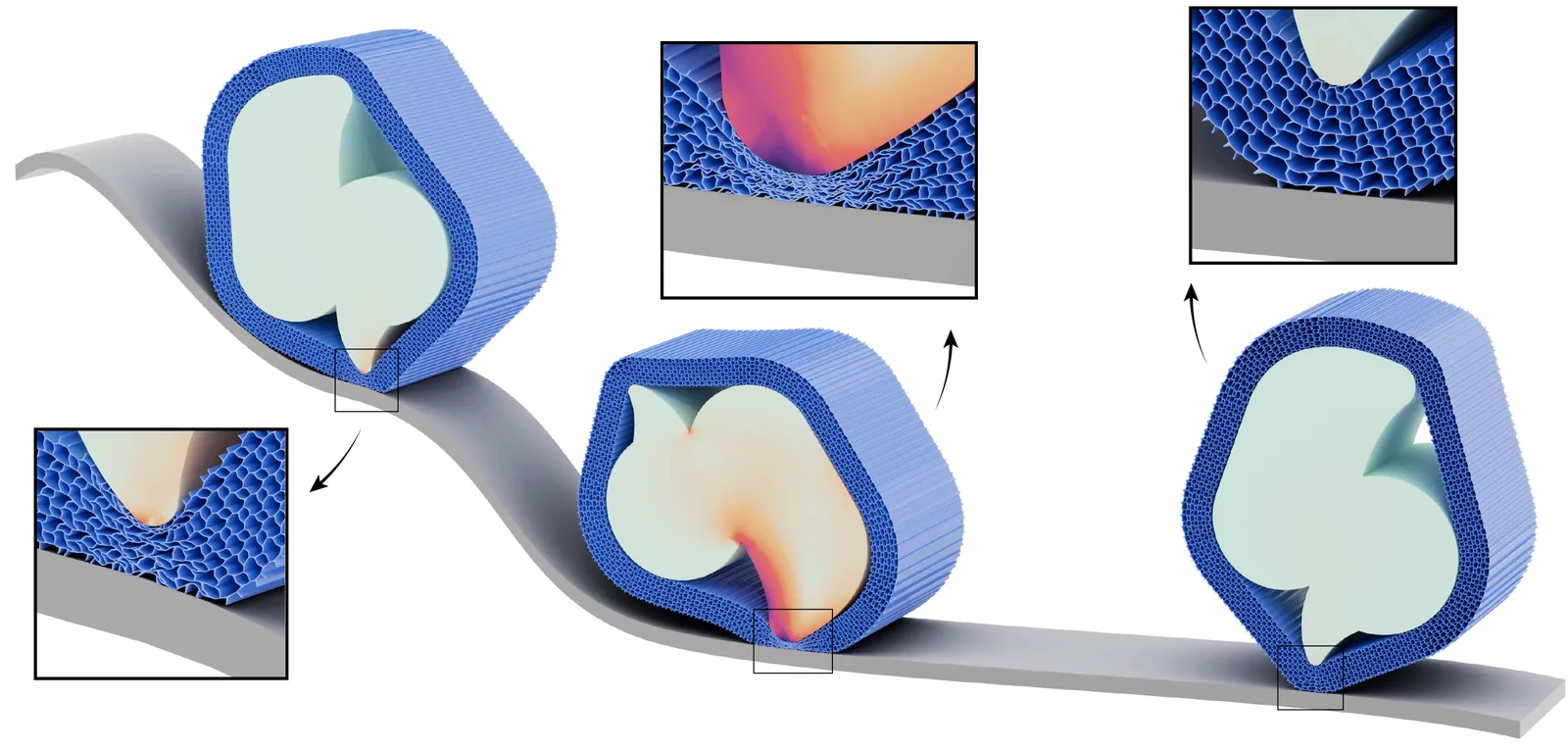
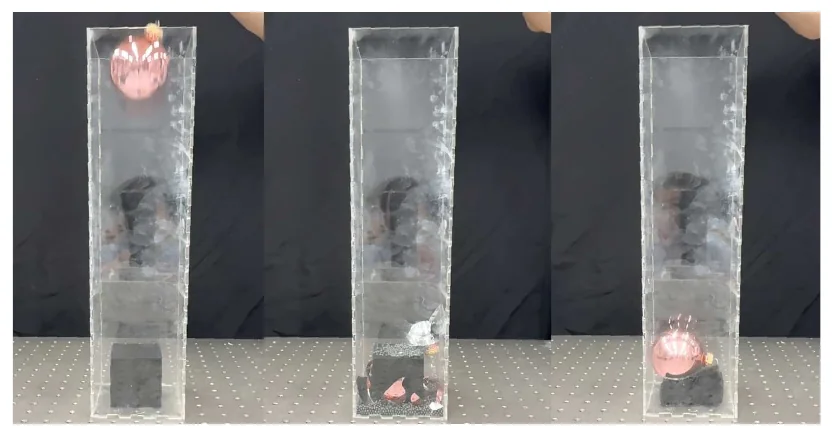
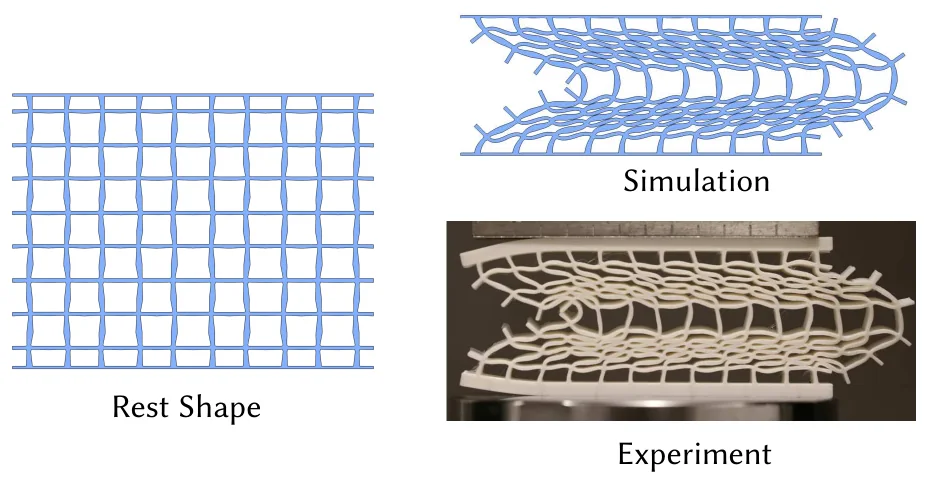
Drop tests, simulated and physical
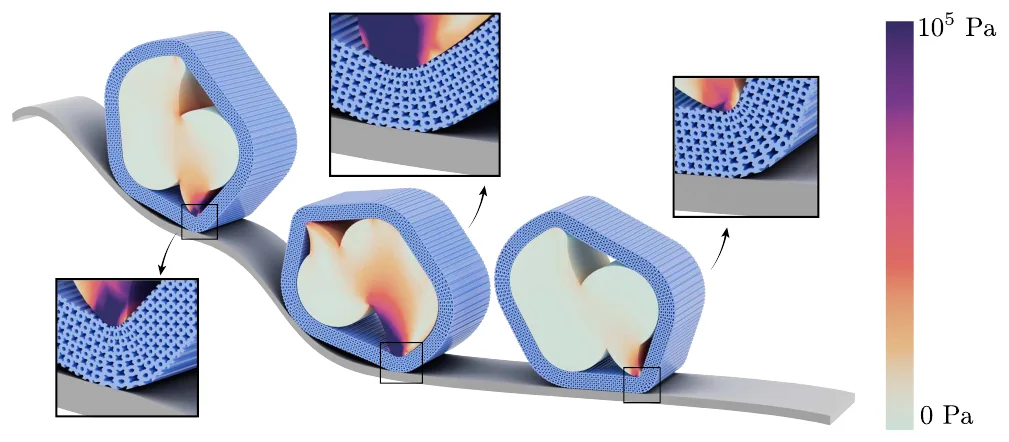
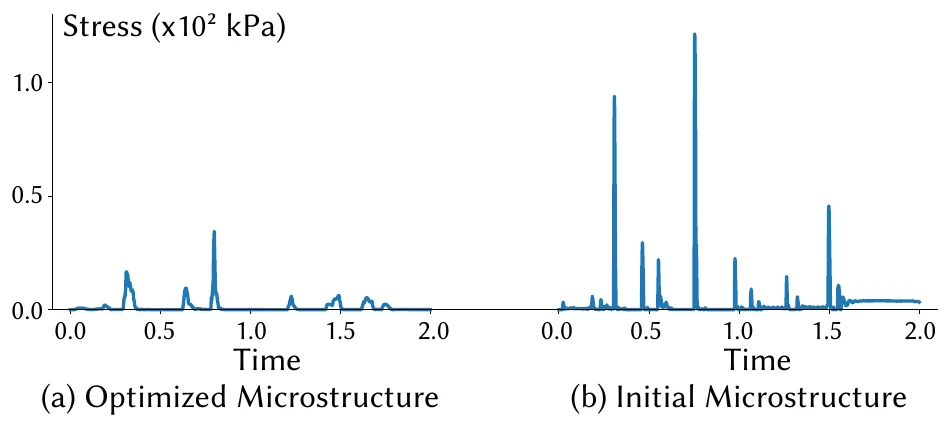
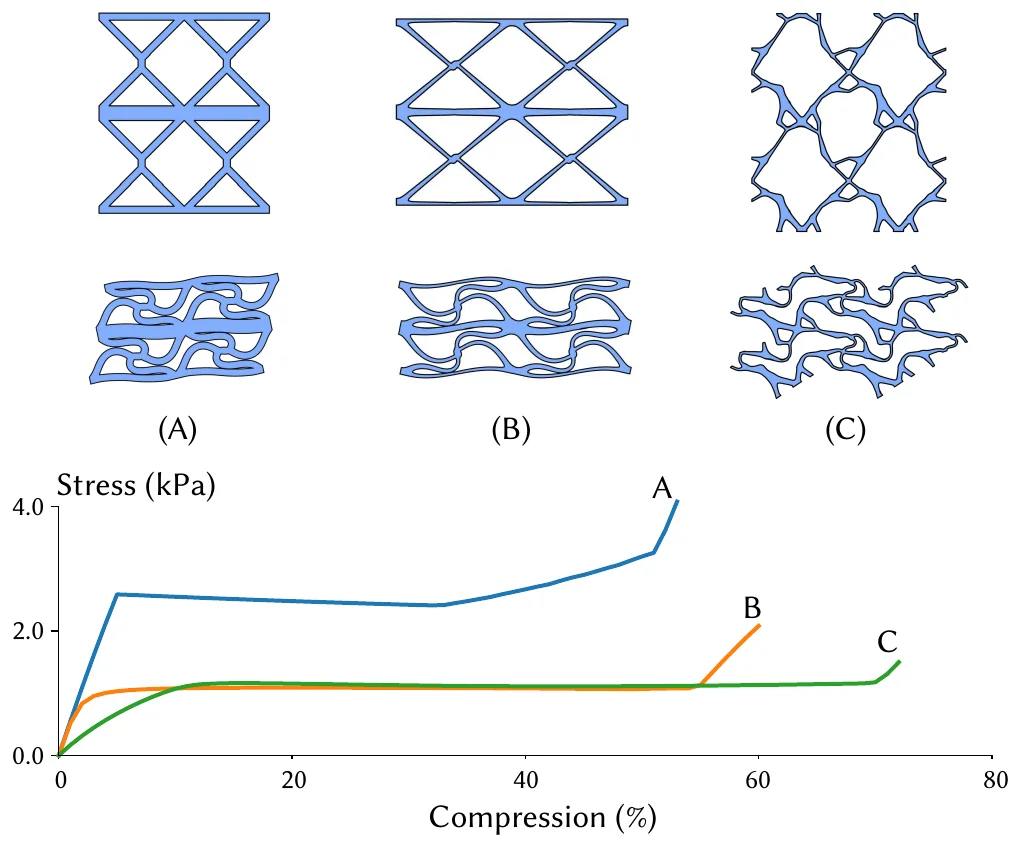
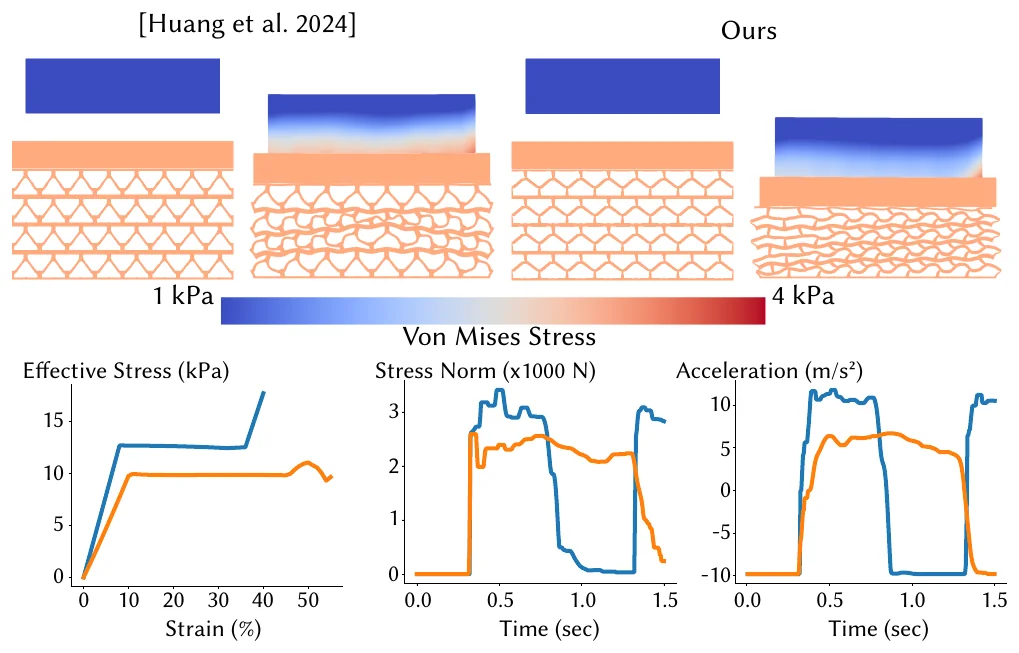
Comparisons with prior work
Method
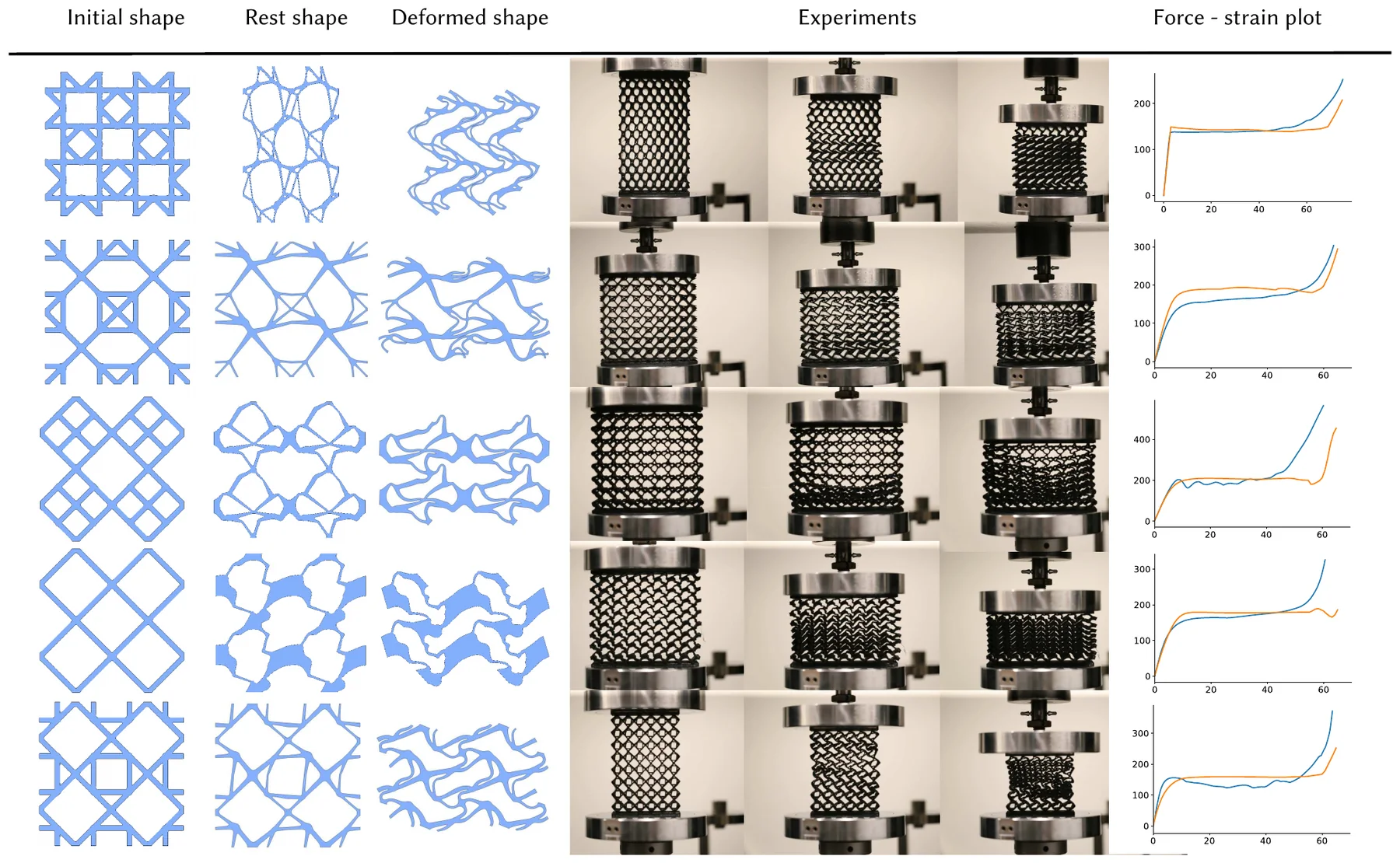
A material that protects well against shock has a highly non-linear elastic response: its reaction force should stay as close to constant as possible while it deforms. We search for 2D microstructure families with that property, then extrude and 3D print them.
1. Homogenize. We formulate the effective stress–strain dependence of a non-linear periodic structure under large displacement, with self-contact and a non-linear base material law. Contact is not optional here — a pattern optimized without it develops much higher stress than predicted once the cells touch.
2. Optimize the shape. The homogenization is differentiable, so the cell geometry (up to 80 parameters) is optimized directly against the target constant stress. Optimizing the cell rather than a full multi-cell structure gets a better result in less time and memory.
3. Search topologies. An extensive search over 105 candidate connectivities finds those that can hold a flat response, yielding a family parametrized by the target stress. Symmetric tiles are excluded: they buckle into energetically equivalent configurations, which destabilizes large tilings.
The resulting family holds a flat response up to 75% compression, against 57% for the previously known structure of [Joodaky 2020], and can be used directly to design and print shock absorbers.
Citation
@article{10.1145/3687765,
  author    = {Huang, Zizhou and Panozzo, Daniele and Zorin, Denis},
  title     = {Optimized shock-protecting microstructures},
  journal   = {ACM Trans. Graph.},
  volume    = {43},
  number    = {6},
  articleno = {181},
  numpages  = {21},
  year      = {2024},
  month     = nov,
  publisher = {Association for Computing Machinery},
  address   = {New York, NY, USA},
  issn      = {0730-0301},
  doi       = {10.1145/3687765},
  url       = {https://doi.org/10.1145/3687765}
}